November 10, 2026
Does AI Search Traffic Actually Convert? What Businesses Should Measure

Written by
Elijah Reed
AI search traffic may represent a small percentage of a company's website visits, but measuring its value requires more than checking how many people clicked through from ChatGPT.
A recent study of 15.4 million B2B SaaS website sessions found that identifiable AI referrals accounted for just 0.88% of traffic. More interestingly, 36.4% of conversions associated with an identifiable AI referral occurred during a later website session.
That raises an important question for business owners investing in generative engine optimization (GEO): Are you measuring the value of AI recommendations, or just the traffic they send immediately?
At Belorado GEO, we help businesses improve visibility across traditional and AI-powered search. But the objective isn't to accumulate mentions in ChatGPT. It's to make businesses easier to discover, evaluate, and contact.
And those outcomes don't always happen during the first visit.
AI-referred traffic is small, but that doesn't tell the whole story
In October 2026, analytics provider Usermaven published research examining 15.4 million sessions across 150 B2B SaaS websites, covering October 2025 through September 2026.
The researchers found that identifiable AI referrals accounted for less than 1% of total sessions. ChatGPT generated the majority of those referrals, followed by Perplexity and Gemini.
For businesses expecting AI search to replace Google overnight, that's a useful reality check. Traditional organic search, direct traffic, referrals, and other acquisition channels remain important.
But evaluating AI search solely through referral volume creates a second problem.
Consider someone looking for an interior designer. They ask ChatGPT for recommendations, research three firms, and leave without contacting anyone. Two days later, they type one firm's name into Google, visit its website, review the portfolio, and submit a project inquiry.
Which channel generated that lead?
From a last-click reporting perspective, it might be organic search. From the customer's perspective, AI may have introduced the company in the first place.
Both interactions matter, but they represent different parts of the buying process.
More than one-third of observed AI-associated conversions happened later
Usermaven identified 3,758 conversions associated with a recorded AI referral. Of those, 1,369 occurred during later sessions.
Among the later conversions, 83.7% happened during visits attributed to direct traffic or organic search.
That doesn't mean AI caused all those conversions. Nor does it capture every instance of someone researching a company through an AI assistant before visiting its website independently.
It does demonstrate something important: a customer journey can involve multiple channels, and the channel that receives credit at conversion may not be the channel that introduced the business.
For professional service businesses, this is particularly relevant. Hiring an architect, choosing a builder, or selecting an interior designer generally involves more consideration than purchasing an inexpensive consumer product.
Prospects might compare recommendations, examine portfolios, read reviews, and revisit a firm's website several times before reaching out.
An SEO or GEO report that counts only immediate conversions risks missing part of that process.
Are AI visitors more likely to contact businesses?
This is where the conversation gets interesting, but also where marketers need to be careful with claims.
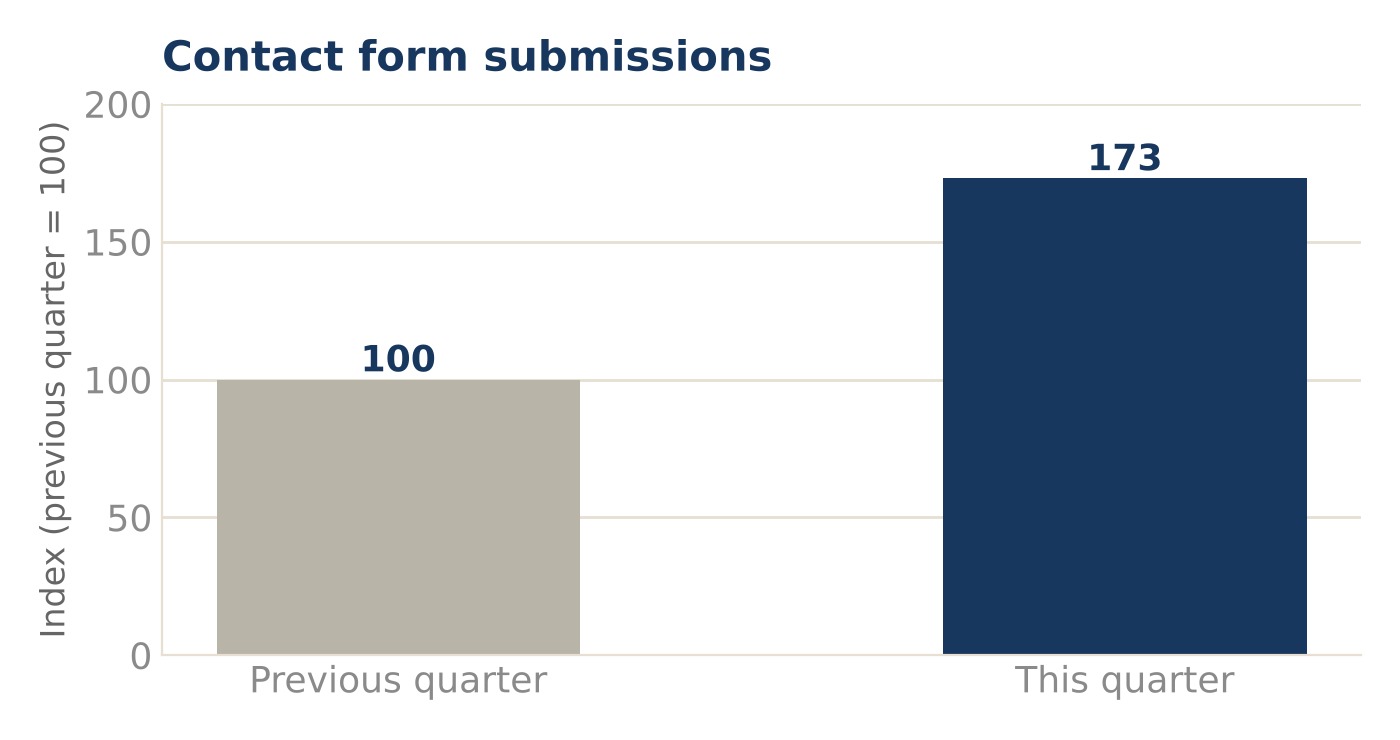
In one architecture firm's analytics reviewed by Belorado GEO, AI-referred visitors initiated contact forms at a substantially higher rate than visitors from other channels during the measured period.
It's an encouraging observation, but the sample of AI visitors was small. Form starts also aren't equivalent to completed inquiries, and the difference could reflect visitor intent, channel composition, or other factors.
It would be misleading to conclude from that single example that AI traffic universally converts better.
What the data does suggest is that businesses should look beyond raw session totals when assessing the quality of AI-referred traffic.
A source delivering 30 highly relevant visits could be valuable even if another source delivers hundreds of visitors who never take a meaningful action.
The question is whether those visits contribute to actual business outcomes.
What businesses should measure instead
A practical GEO measurement framework should connect three stages of the customer journey.
1. Visibility: Are you being recommended?
The first step is understanding whether AI platforms recommend your business for relevant commercial questions.
For a residential architecture firm, that might include searches such as:
- Who are the best residential architects in Eugene?
- Which Oregon architects specialize in custom homes?
- Can you recommend an architect for a renovation in Central Oregon?
At Belorado GEO, we test relevant recommendation prompts and monitor how frequently a business appears compared with competitors.
This provides a directional view of recommendation visibility. It isn't a universal ranking, because AI answers can vary by prompt, platform, location, and time.
2. Engagement: What happens after someone visits?
The second step is evaluating visitor behavior.
Useful measures include engaged sessions, contact-page visits, booking interactions, form starts, and other actions that indicate potential commercial interest.
For a winery, that might mean tasting reservations. For a tour company, completed bookings. For an architecture firm, the beginning of a project inquiry.
The actions worth measuring should reflect how the actual business makes money.
This is why Belorado GEO combines search visibility work with website design and conversion considerations. Driving a relevant visitor to a confusing website doesn't accomplish much.
3. Outcomes: Did the visit contribute to an inquiry or sale?
The third step is connecting acquisition channels to results.
Track completed forms, purchases, reservations, and qualified inquiries. Where possible, examine returning visitors and multi-session journeys rather than relying exclusively on last-click attribution.
It can also help to ask new customers how they discovered the business, including whether an AI assistant recommended it.
Self-reported attribution is imperfect, but it can reveal discovery paths that standard referral tracking misses.
Together, these measurements offer a more useful picture than simply celebrating that a company appeared in ChatGPT.
The role of traditional SEO hasn't disappeared
One misconception surrounding GEO is that businesses need an entirely separate optimization strategy disconnected from Google.
Google's own guidance emphasizes that the fundamentals remain relevant to its generative AI search experiences: crawlable pages, useful original information, clear website structure, strong page experience, and structured data that accurately represents visible content.
Google has also introduced dedicated reporting for generative AI appearances in Search Console, giving website owners additional visibility into how their content is surfaced.
Those reports are valuable, but Google AI appearances, referral traffic from third-party assistants, and actual conversions are different measurements. None should be substituted for the others.
At Belorado GEO, we treat technical SEO, content, local authority, AI visibility, and website usability as complementary work. Different businesses need different priorities, but the objective stays the same: make it easier for the right customer to find and choose the business.
How to evaluate your current SEO or GEO agency
If you're paying for SEO or AI search optimization, ask your provider to explain what its reports actually demonstrate.
Are the AI visibility numbers based on a repeatable set of prompts? Are comparisons made across consistent periods? Can the agency distinguish increased exposure from increased traffic? Is it tracking actual inquiries, or only impressions?
Be especially cautious of claims that a business has achieved a permanent ranking inside ChatGPT. AI recommendation results are variable, and no agency can guarantee placement across all users and questions.
A credible agency should be able to explain what it knows, what remains uncertain, and which improvements it is pursuing next.
The bottom line: Measure the customer journey, not just the click
AI search does not need to account for most of your traffic to deserve attention.
But businesses shouldn't assume that every AI mention is valuable, or that every visitor from ChatGPT is ready to buy.
The better approach is to measure visibility, engagement, and business outcomes together, while recognizing the limitations of attribution.
Want to understand how customers discover your business through Google and AI search? Belorado GEO audits your current visibility, compares relevant competitors, and identifies practical website and search improvements worth prioritizing.
The goal isn't simply to get mentioned more often. It's to make those recommendations commercially useful.