

Belorado helps custom home builders increase visibility across Google, local search, AI Overviews, ChatGPT, and other discovery platforms. We build the search strategy, location pages, service content, authority signals, and conversion paths needed to attract qualified homeowners before they have chosen which builder to call.

A prospective client rarely begins by searching for your company by name. They search for “custom home builders near me,” “best luxury home builder in [city],” “modern home builders in [region],” or “how much does it cost to build a custom home?” They compare portfolios, read reviews, investigate building processes, and look for signs that a builder understands the type of home they want. Increasingly, they also ask AI tools to recommend reputable builders or explain which companies specialize in a particular architectural style.
If your website does not appear during those early searches, another builder gets the opportunity to shape the buyer’s shortlist. The problem is not necessarily your craftsmanship, reputation, or experience. It is that search engines and AI platforms may not have enough clear, relevant information to understand where you build, what you specialize in, and why a homeowner should consider you.
Belorado creates search visibility systems for custom home builders. We connect technical SEO, local search, high-intent content, project proof, and AI search optimization so your company can be discovered throughout the homeowner’s research journey, not only after someone already knows your name.
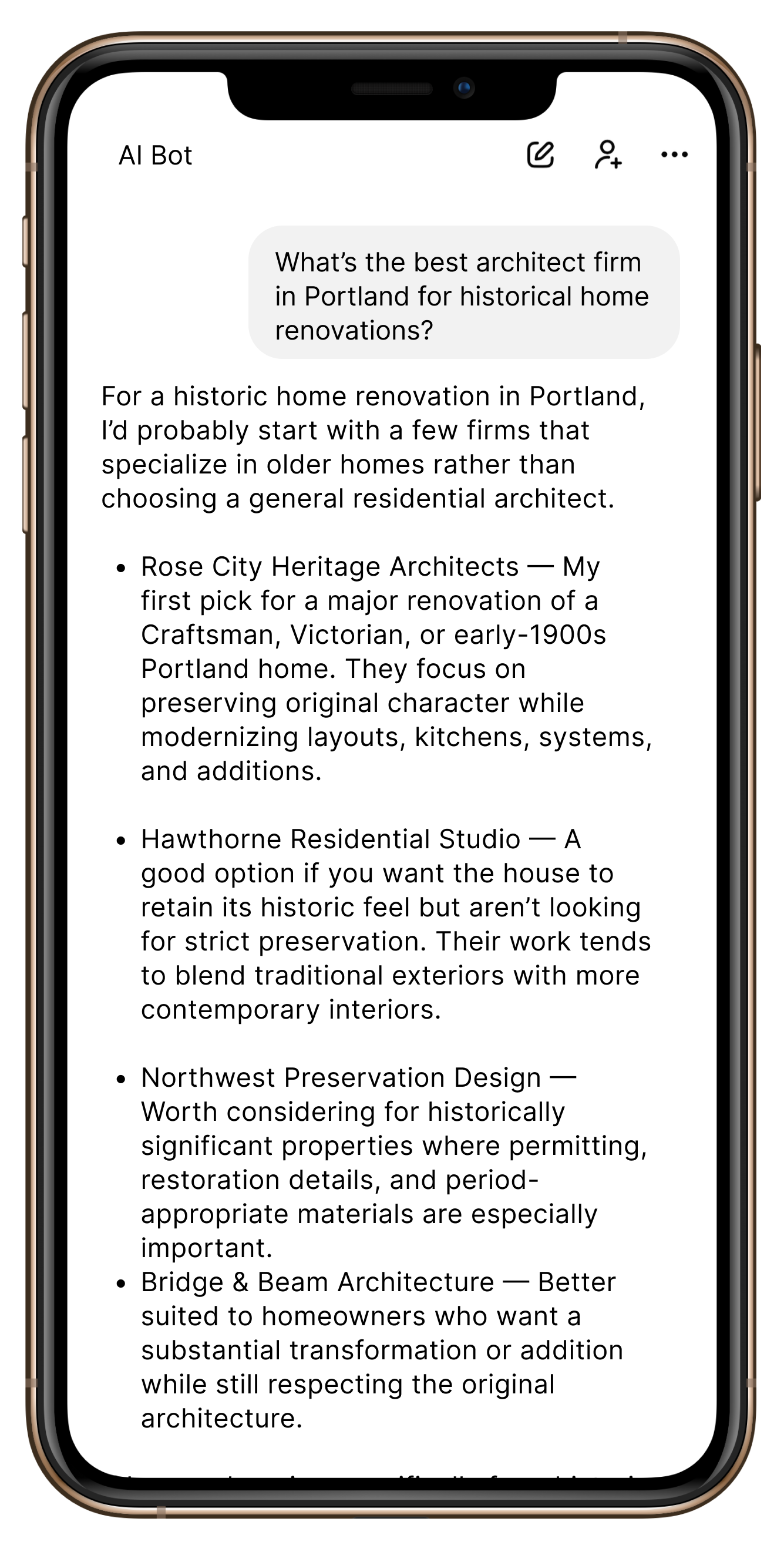
Belorado develops a connected visibility system rather than treating SEO as a collection of isolated blog posts or technical fixes. Each part of the strategy helps search engines understand your company while giving prospective clients the information they need to move forward.
We identify the commercial and informational searches that matter in your markets. This includes direct service queries such as “custom home builder in [city],” specialty searches such as “luxury waterfront home builder,” and decision-stage questions involving cost, process, land, design, financing, and timelines. We also study which builders, directories, publications, and marketplaces currently appear for those searches to find realistic opportunities to compete.
A single services page cannot clearly communicate every type of project you want to win. We build focused pages for relevant specialties such as luxury custom homes, build-on-your-lot construction, design-build services, energy-efficient homes, modern homes, vacation properties, additions, or whole-home transformations. Each page is written around a real client need and supported by appropriate projects, expertise, and calls to action.
We create useful location pages for the cities and regions where you genuinely work. These pages go beyond swapping city names. They can address local architecture, permitting considerations, lot conditions, climate, neighborhood expectations, project examples, and the specific services available in that market. This gives homeowners locally relevant information while helping search engines understand your geographic reach.
A project gallery shows what you built. A detailed project story explains how you think. We turn selected portfolio work into search-ready case studies describing the client’s goals, property constraints, design direction, construction challenges, materials, collaboration process, and finished result. These stories create stronger evidence of experience and give prospects a more meaningful way to evaluate your capabilities.
High-value prospects often conduct extensive research before contacting a builder. We develop authoritative resources answering questions such as “how much does it cost to build a custom home in [region],” “how long does the custom home process take,” “should I hire an architect or builder first,” and “what should I look for in a custom home builder?” Transparent, well-structured answers build trust while reaching prospects earlier in their decision process.
We strengthen the relationship between your website, Google Business Profile, service areas, project locations, reviews, business listings, and other local signals. The goal is to make your company easier to verify and more competitive when homeowners search for builders nearby or request location-specific recommendations.
Homeowners are increasingly asking complex questions that require comparisons and recommendations. We organize your services, locations, expertise, projects, and frequently asked questions so search and AI systems can interpret them more easily. This includes clear page structure, consistent company information, descriptive language, internal linking, structured data where appropriate, and third-party signals that corroborate your expertise.
Visibility only matters when it creates qualified conversations. We improve the path from search result to inquiry with clearer positioning, relevant proof, carefully placed calls to action, and forms that collect enough information to assess fit without overwhelming the prospect. The objective is not simply more traffic. It is more conversations with homeowners whose project type, geography, timeline, and expectations align with your business.


Custom home building is a high-value, low-volume business. You do not need thousands of anonymous visitors or hundreds of low-quality form submissions. You need consistent visibility in front of the smaller group of homeowners with suitable land, realistic budgets, the right location, and a genuine intention to build.
That makes search visibility especially valuable. A useful location page, specialty page, or project case study can continue attracting and educating potential clients long after it is published. Unlike an advertisement that stops producing attention when the budget is paused, a well-built search asset can compound as it earns authority, internal links, engagement, and supporting evidence.
We evaluate performance around business outcomes, not vanity metrics. Rankings and traffic help us diagnose progress, but qualified inquiries, booked consultations, opportunity quality, and attributable revenue are the measures that ultimately matter. The strategy is designed to help your company compete for the right projects, protect future pipeline, and become a recognizable authority in the markets you serve.
1. Diagnose the current visibility gap
We begin with your website, search performance, Google Business Profile, competitors, reviews, service areas, project mix, and existing lead sources. We identify technical barriers, missing pages, weak positioning, and the searches for which your company should reasonably be visible. This gives us a prioritized strategy instead of a generic list of SEO tasks.
2. Build the search and content architecture
We map your highest-value services, specialties, locations, projects, and buyer questions into a clear site structure. Every recommended page receives a specific purpose, target query family, internal-linking role, and intended next action. This prevents overlapping pages and creates a coherent path from initial research to consultation.
3. Publish, optimize, and strengthen authority
We improve existing pages and create the missing assets required to compete. Depending on the opportunity, this can include service pages, location pages, project stories, cost guides, process explanations, FAQs, technical improvements, structured data, Google Business Profile enhancements, and relevant authority-building campaigns.
4. Measure qualified demand and refine
We monitor visibility, search queries, local performance, AI citations where measurable, engagement, inquiries, and lead quality. The findings guide the next round of improvements. Pages that show early traction can be expanded, weak conversion paths can be repaired, and new content can be prioritized using actual market response rather than guesswork.
SEO for custom home builders is the process of making a building company more visible when homeowners search for services, locations, specialties, and answers related to designing and constructing a custom home. It can include technical website improvements, local SEO, service pages, location pages, project case studies, educational content, review strategy, internal linking, and authority building. The strongest strategies connect these activities to the builder’s actual markets and ideal project types.
Start by defining the projects you want, including geography, home type, budget range, timeline, and client profile. Then create search pages that clearly address those needs and support the claims with relevant projects, reviews, process information, and local evidence. A shorter form may generate more submissions, but a thoughtfully designed qualification path often produces better conversations. The goal is to increase suitable opportunities, not simply the total number of leads.
The right targets usually include a combination of local commercial searches, specialty searches, and homeowner questions. Examples include “custom home builder in [city],” “luxury home builder near me,” “build on your lot builder,” “modern custom home builder,” “cost to build a custom home in [region],” and “custom home building process.” Final priorities should reflect the builder’s actual services, locations, competitive landscape, and project economics.
There is no guaranteed submission process that forces an AI platform to recommend a company. The practical approach is to make your business easy to understand and verify across the web. That means publishing clear information about your services, locations, specialties, people, projects, and process while maintaining consistent business information, credible reviews, relevant third-party mentions, strong technical accessibility, and structured data where appropriate. These signals give search and AI systems better evidence to interpret.
A strong website typically includes dedicated pages for primary services, meaningful specialties, legitimate service areas, the building process, company experience, individual projects, testimonials, frequently asked questions, and contact or consultation information. Builders may also benefit from detailed resources about cost, timelines, land evaluation, architecture, design collaboration, permitting, selections, and what clients should expect before construction begins.
Only when the page can provide genuine local value. Publishing dozens of nearly identical pages with different city names creates a weak experience and provides little evidence of actual local expertise. A strong location page should explain what you build in that market, demonstrate relevant experience, discuss local considerations, and connect visitors with appropriate projects and services.
Timing depends on the website’s current condition, market competition, geographic reach, existing authority, and the amount of useful content already available. Technical and conversion improvements can have an immediate operational benefit, while meaningful gains in competitive organic visibility generally develop over time. We establish baseline measurements, prioritize attainable opportunities, and report progress against both visibility and lead quality.
Yes. Google Business Profile can influence how a builder appears in local discovery and gives homeowners access to reviews, photographs, business details, and direct contact options. It should accurately represent the business, comply with Google’s eligibility rules, and remain consistent with the information published on the company’s website and other trusted sources.
The appropriate investment depends on market size, competition, growth goals, service-area complexity, current website quality, and the value of a typical project. A regional builder pursuing several project types across multiple cities will require a different strategy from a specialized builder serving one community. The better question is whether the expected value of additional qualified opportunities justifies the work required to earn and maintain visibility.
